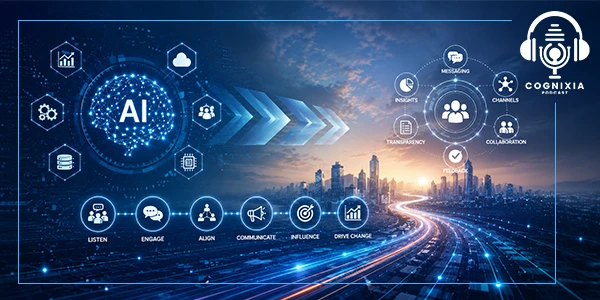

Artificial intelligence is redefining how enterprises operate, innovate, and compete. As organizations integrate AI into decision-making, automation, and customer engagement, leadership itself is undergoing a fundamental shift. Success today depends on developing the right leadership skills for AI era – skills that combine strategic clarity, ethical responsibility, and human-centric thinking. For enterprises navigating large-scale transformation, leadership readiness has become as important as technology readiness.
Why Leadership Skills for the AI Era Matter for Enterprises
AI adoption introduces speed, scale, and complexity into enterprise environments. Leaders are expected to guide intelligent systems alongside human teams while ensuring accountability and trust. Without strong leadership alignment, AI initiatives often remain isolated pilots that fail to deliver enterprise-wide value.
Organizations that prioritize leadership skills for AI era are better positioned to align AI investments with business goals, manage change effectively, and foster workforce confidence. Leadership acts as the critical link between advanced technology and sustainable business outcomes.
From Traditional Leadership to AI-Aware Leadership
Traditional leadership models were designed for predictable environments and linear decision-making. AI-driven organizations operate in constant motion, where insights evolve rapidly and decisions must balance data with judgment.
AI-aware leadership emphasizes adaptability, collaboration, and continuous learning. Leaders must shift from control-based approaches to enabling experimentation and cross-functional alignment. While AI supports decision-making, human accountability remains central to organizational success.
Human-Centric Leadership in an AI-Driven Workplace
As automation expands, employees often experience uncertainty about roles and career paths. Human-centric leadership helps organizations address these concerns while building trust in AI adoption.
Effective human-centric leaders focus on:
- Transparent communication about how AI supports business goals
- Empathy toward employee concerns around automation
- Clear linkage between AI adoption and skill development
- Encouraging collaboration between humans and intelligent systems
[cognixia_posthumb]
By combining leadership development with structured enterprise upskilling programs, organizations enable employees to transition confidently into future-ready roles. Explore Enterprise Upskilling Programs
Building a Digital Leadership Mindset
Leadership in the AI era does not require technical specialization, but it does require digital confidence. Leaders must understand how AI impacts business models, workforce dynamics, and customer experience.
A digital leadership mindset is characterized by:
- Commitment to continuous learning and adaptability
- Data-informed decision-making without over-reliance on algorithms
- Collaboration between business, technology, and data teams
- Alignment of AI initiatives with long-term enterprise strategy
Organizations that invest in workforce transformation consulting ensure leadership capabilities evolve alongside AI adoption, enabling scalable and responsible growth. Learn more about Workforce Transformation Consulting
Closing Thoughts
AI may be transforming how work gets done, but leadership defines how organizations navigate that transformation. Enterprises that invest in leadership skills for AI era – grounded in empathy, adaptability, and ethical responsibility – are better equipped to build trust, scale innovation, and prepare their workforce for an AI-driven future. Human-centric, digitally confident leadership will remain the foundation of sustainable enterprise success.